
Where Neuralyze Works
Machine Vision is most commonly used for quality assurance in production facilities; but it is also used for sorting recyclable materials, detecting contaminants in food, and automating laboratory analyses. The scope encompasses any process that can be automated, in which camera systems are used to visually capture and verify the current state.


Surface Inspection
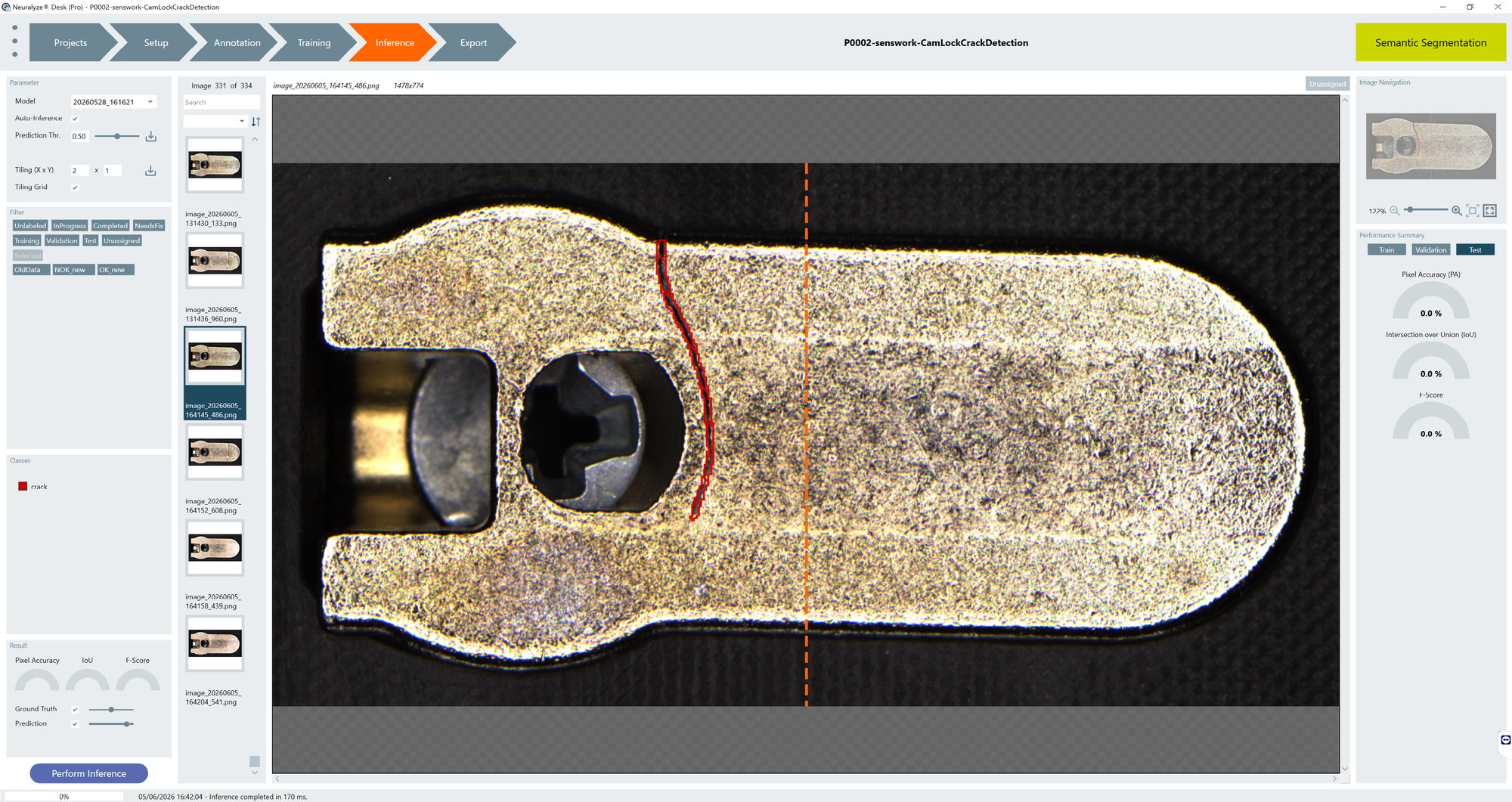
Detecting scratches, cracks, inclusions, discoloration for surface defects on metal, glass, plastic, or ceramic…

Completeness Analysis
Checking for the presence of components, incomplete assembly, completeness check…

Dimensional Accuracy Check
Dimensional inspections such as length, width, angles, radius…

ext Recognition (OCR)
Reading letters, symbols, or markings such as laser-etched or printed date and lot codes…

Anomaly Detection
Detecting features that deviate from the average of the parts without having previously trained the system on defective parts…

Identify, Sort, and Count
High-speed part recognition, sorting, robotic picking, discharge, allocation, and counting…
Detect Surface Defects
Scratches, cracks, inclusions, discoloration for surface defects on metal, glass, plastic, or ceramic are among the most challenging inspection tasks. No two scratches look alike. Rule-based systems must store a separate definition for each type of defect; and when there is high variability, parameterization becomes a bottleneck.
Where rule-based approaches reach their limits
- High Variability – Natural products, organic materials, or handcrafted parts exhibit variability that is difficult to capture in rules.
- Complex Surfaces – Transparent materials, reflective surfaces, and curved geometries make it difficult to use simple threshold-based methods.
- Defects that are difficult to define – “I’ll know it when I see it” accurately describes many industrial inspection tasks.
What Neuralyze® delivers
Instead of defining defects, you show the system examples. It extracts the relevant features on its own. Adjustments are made through retraining rather than reprogramming.
Typical Applications
Automotive (body, interior), metalwork, glass industry, semiconductor manufacturing
Verify Completeness. Do it reliably.
To find missing components and incorrect or incomplete assembly requires completeness checks for reliable detection and differentiation of many different objects in a scene.
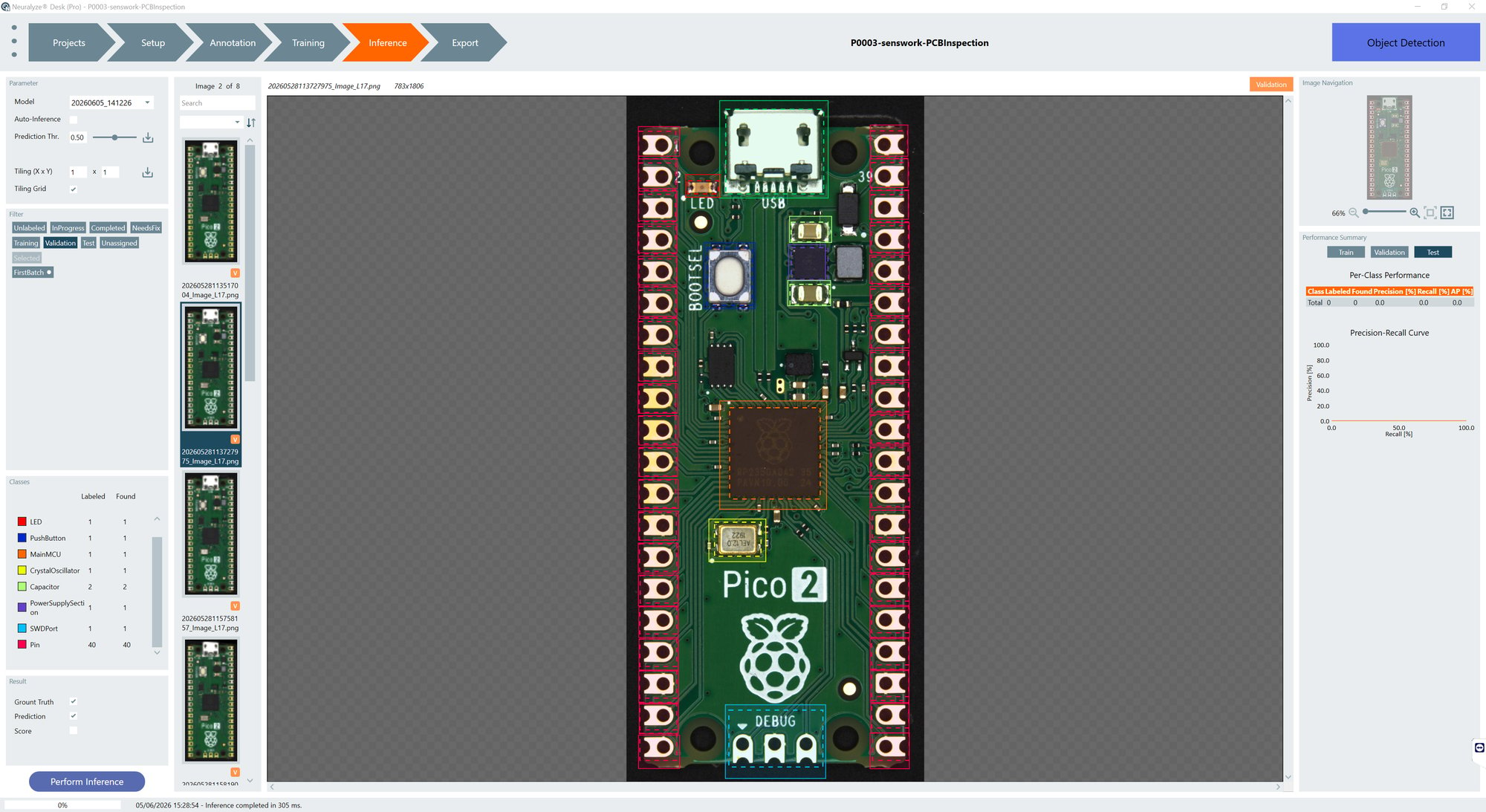
Practical examples: Trays in the food industry, hospital supply kits, or assemblies in electronics manufacturing all require that items be correctly placed before the final inspection. Object recognition with deep learning reliably solves this task.
What Neuralyze® Does
Object recognition locates and distinguishes many different objects in a scene. This makes it suitable for presence checks as well.
Typical Applications
Food industry, medical technology, electronics manufacturing, assembly lines
Check Dimensional Accuracy and Geometry
Dimensional inspections—length, width, angles, radii—are a core area of traditional image processing, which is precise, deterministic, and fast. Conventional rules such as “Find an edge” or “Is this hole circular?” work reliably when objects can be clearly defined.
Neuralyze® complements this strength in cases where rule-based approaches struggle to locate the object being measured or segment relevant areas.
Hybrid Approach
In hybrid inspection workflows, Neuralyze handles object recognition and segmentation, while traditional algorithms perform the measurement. It's the best of both worlds.
Typical Applications
Mechanical engineering, precision manufacturing, medical technology
Read Labels and Codes
Printed text, such as date and lot codes, on curved surfaces or surfaces that are difficult to see clearly is hard for conventional OCR systems to read.
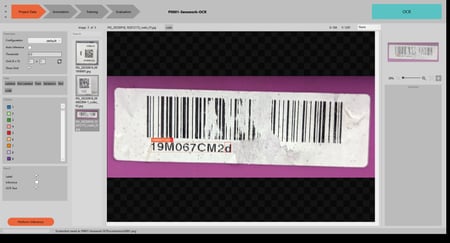
Practical Example: Inspecting Labels on Curved Surfaces
Deep Learning significantly simplifies this process and delivers consistent results even when the print is difficult to read.
What Neuralyze® Does
Deep Learning-based text recognition achieves reliable results even under these challenging conditions:
• Curved surfaces (bottles, cans, tubes)
• Challenging lighting conditions and reflections
• Varying print quality
Typical Applications
Pharmaceuticals (serialization), food packaging, beverage industry, logistics
Detect Unknown Deviations
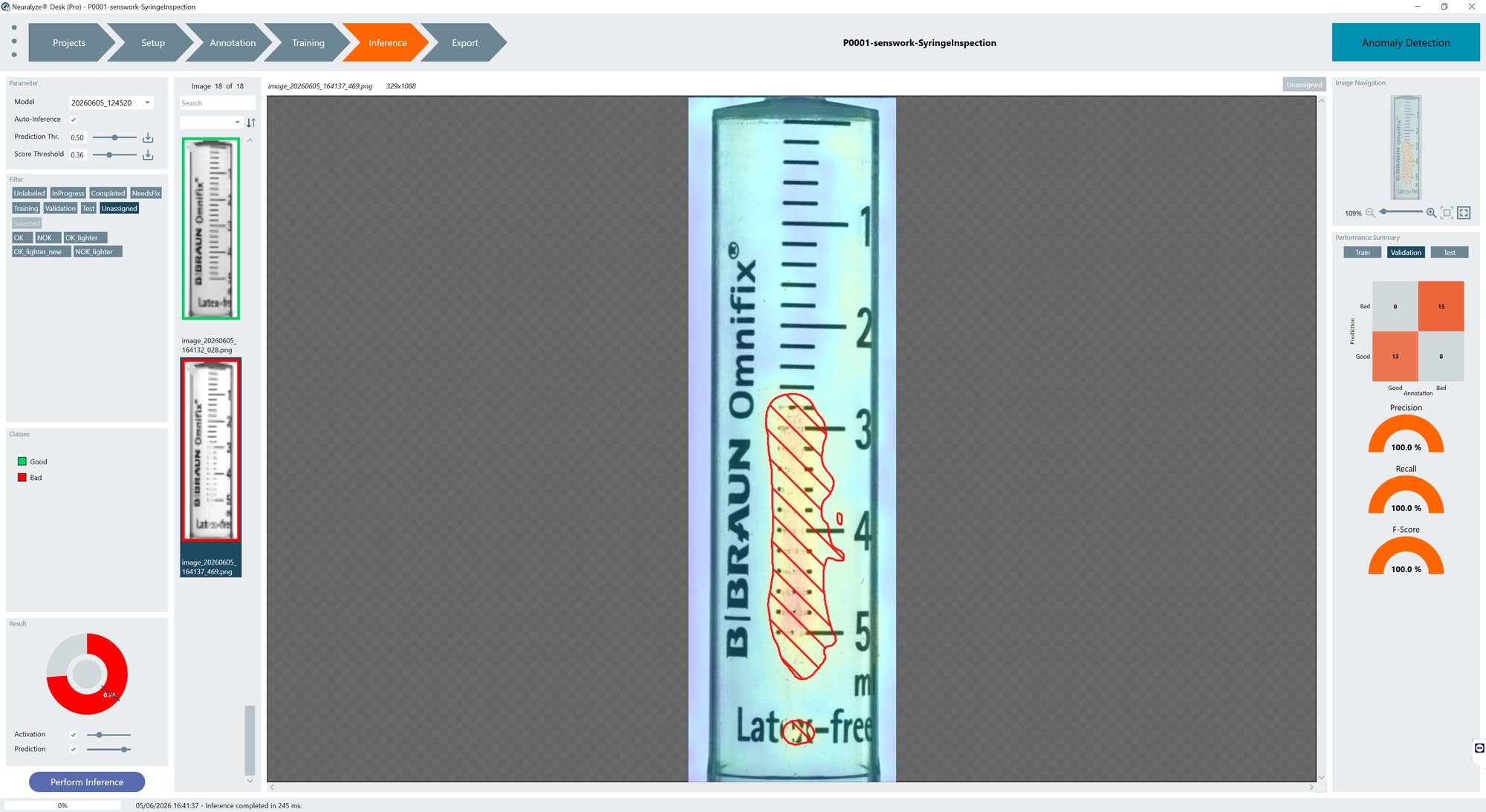
Rule-based systems only find what they are explicitly looking for. New, unforeseen types of errors are overlooked.
The Alternative Approach
Anomaly detection takes a fundamentally different approach. Instead of defining individual defect classes, the system learns what a good product looks like and detects deviations from that standard.
What Neuralyze® Does
The model is trained exclusively on good parts and subsequently detects any deviations from the learned standard, including unknown defect types.
Typical Applications
Semiconductor manufacturing, high-precision parts, first-article inspection, continuous manufacturing processes
Distinguish between different products with confidence
Many production processes involving variable products require reliable detection, sorting, and counting of objects. Neuralyze reliably distinguishes between visual features that can no longer be reliably distinguished using conventional image processing.
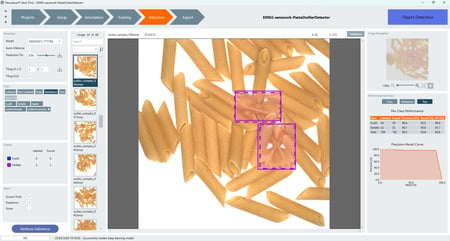
Case Study: Optical Inspection of Pasta Gnocchi and Spaetzle are produced on the same production lines. During product changeovers, it is essential to ensure that each variety is packaged separately despite their significant differences in shape. Object recognition using deep learning reliably solves this problem.
What Neuralyze® Offers
Object recognition locates and distinguishes many different objects in a scene, making it equally suitable for identification, sorting, and counting tasks.
Typical Applications
Food industry, electronics manufacturing, packaging industry, assembly lines
Your Audit Assignment, Our Assessment
Not every inspection task is suitable for Vision AI. Before you invest, we'll analyze the feasibility using your data.
Here's how it works:
1. Provide image data – You send us sample images of your inspection task (good parts, defective parts, typical variations)
2. Analysis by our team – We evaluate image quality, feature variability, and the likelihood of success
3. Results and recommendations – You receive a well-founded assessment of whether and how Neuralyze can solve your task
What You'll Get:
- Realistic assessment of the chances of success
- Recommendation for a camera system and lighting (if applicable)
- Rough estimate of the effort required for training and integration
- If the evaluation is positive: Proposal for a pilot project or direct license
Costs:
The initial feasibility analysis is free of charge and non-binding. For more extensive preliminary studies involving prototype development, we will provide a customized quote.