
How Neuralyze® works
Machine Learning has been used in industrial image processing for over 20 years. Since around 2015, development has accelerated significantly thanks to new methods such as Deep Learning, leading to highly effective approaches that are collectively referred to as Vision AI.
When it comes to complicated tasks, the question today is no longer whether to use Vision AI in production, but rather how to make the most effective use of its capabilities.

Convolutional Neural Networks
At the heart of Neuralyze are convolutional neural networks (CNNs), a class of neural networks that is particularly well-suited for image data. They are based on the concept of describing information rather than generating it. The system recognizes patterns and regularities in the data available to it.
The Core Principle:
Learning instead of Programming
Imagine you want to teach a system to detect scratches on metal surfaces.
Rule-based approach: You define rules such as, “Look for dark lines longer than 2 mm, but ignore edges unless the contrast ratios...”. This works as long as your world follows these rules. Complex variability leads to complex rule systems that eventually become unmanageable.
Vision AI Approach: You show the system 5,000 images with identified scratches. It finds patterns on its own, even those that are difficult to capture in rules.
The difference is fundamental. Instead of writing code, you train. Not defining rules, but providing examples.
Different Tools for Different Tasks
Vision AI answers questions such as: “Is this component defect-free? Where exactly is the defect? What category does this product belong to? How many objects are on this conveyor belt?”
Your data stays with you
In complex production processes, there are many inspection steps leading up to the finished product. Ultimately, the image data documents the entire production process in which no manufacturer is eager to disclose. This explains why the image data is so valuable.
Neuralyze® runs entirely on-premises. Training and inference take place on your own hardware, within your network, and under your control. No cloud connection, no external data processing.
Specifically
• GDPR compliance through local data processing
• No licensed telephony
• WIBU dongles work offline
• Trade secrets remain within the company
• Full control over training data, models, and test results
From Concept to Production Model
Neuralyze® is a single, end-to-end graphical application that combines all the steps required to implement AI for image analysis, and does not require any programming knowledge.
1. Examine the process, collect data, and evaluate it
The starting point is analyzing the inspection task and the systematic acquisition of image data.
2. Sort Data
Separating relevant images from irrelevant ones.
3. Clean the Data
Removal of incorrect or non-representative images.
4. Preprocess and Label Data
Annotate the relevant parts of the images. Optional: Data augmentation to artificially increase the dataset size.
5. Train the Model
You choose the network architecture; Neuralyze optimizes the parameters.
6. Validate the Model
Evaluating model performance using test data.
7. Implement in Production
Deployment of the validated model to the production environment.
Iterate the Workflow
After the production phase, new data is collected and the model is retrained.
Achieve the Goal
AI expertise moves to where the production know-how is— to you.
In Production
Deploying a trained model into production is just the beginning, not the end. The inference execution time is an important factor, as it determines the cycle time of the testing process.
Inference Monitoring
Log inference times, confidence values, and decision distributions.
Model Management
Different model versions can be managed in parallel, compared, and rolled back if necessary.
Data Feedback
Images from production operations can be systematically collected and used for follow-up training.
Industrial Research as a Foundation
Our Background
Since 2011, senswork has been developing turnkey solutions for industrial image processing, optical inspection, and test equipment engineering. Our systems and software products are used daily in numerous industries, including the automotive industry, mechanical engineering, and medical technology.
Vertical Integration
We offer end-to-end machine vision systems from a single source. We have all the necessary expertise in-house, from design, control cabinet construction, electronics, custom machine building, and imaging systems design right through to the complete software stack. This enables us (despite the high level of complexity) to offer inspection systems with optimally coordinated and reliably integrated subsystems, including very short commissioning times.
Batch Size One
For us, producing runs in the double-digit range is just as much a part of our daily business as Batch Size One solutions tailored to highly specialized manufacturing machines. The requirements at a semiconductor manufacturer are fundamentally different from those at a beverage bottling company. That’s why we focus on mastering technology, not on standard products.
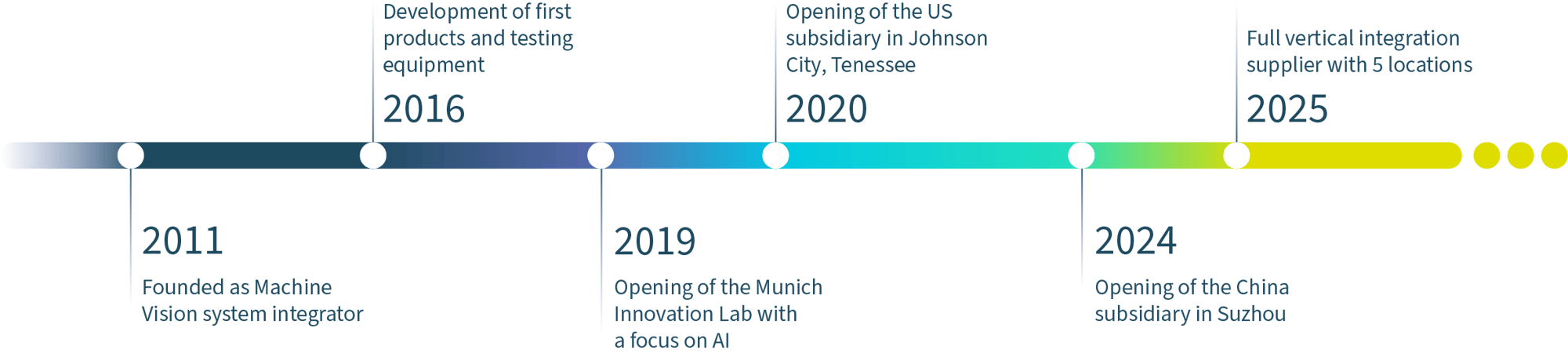
| 2011 | Founded as Machine Vision system integrator |
| 2016 | Development of first products and testing equipment |
| 2019 | Opening of the Munich Innovation Lab with a focus on AI |
| 2020 | Opening of the US subsidiary in Johnson City, Tenessee |
| 2024 | Opening of the China subsidiary in Suzhou |
| 2025 | Full vertical integration supplier with 5 locations |
The Innovation Lab
At the senswork Innovation Lab in Munich, we are constantly developing new approaches to opto-mechanical inspection tasks using AI. By adopting new insights and technologies early on, we can reliably make them available to industry and research as quickly as possible. This enables us to actively shape technological development rather than simply follow it.
Research Collaborations
- Fraunhofer IIS – Joint Research Project DeKIOps
- Bavarian Vocational Schools (ALP Dillingen) – Neuralyze® as a training platform in the curriculum
- Hahn-Schickard-Company
- Friedrich-Alexander University of Nuremberg-Erlangen - Consortium Research
- Helmholtz HEREON - Consortium Research Project
- Collaborations with research institutions and universities to facilitate two-way knowledge transfer and the production of joint publications
Industrial Networking
- VDMA Machine Vision Group – Active participation in the technical group. The VDMA comprises over 130 leading companies. Market volume of 2.8 billion euros in Germany
- BAIOSPHERE – Bavarian AI Agency, Strategic Partnership
- Contribution on Regulatory Frameworks (AI Act Case Studies, EU Consultations)
Numbers
- 35 Employees
- ~€6M Annual Revenue
- Since 2011
- Locations: Burghausen (Headquarters), Munich (Innovation Lab), Bad Honnef, Johnson City, USA, Suzhou, China