

Resources
Documentation, Case Studies, Background Information
Technical documentation, real-world application examples, and background material on Vision AI in industrial quality assurance.

Technical Documentation
-
Neuraylze is designed to run AI-based models and requires a suitable system environment with a modern CPU, sufficient RAM, and a CUDA-capable NVIDIA graphics card. Actual performance depends on model size, input data, batch processing, and the number of concurrently running models.
Components Minimum requirement Recommendation Operating System
Windows 10, 64-Bit Windows 10/11, 64-Bit Processor
Modern multi-core processor Intel Core i5/i7, AMD Ryzen 5/7 or better RAM
16 GB RAM 32 GB of RAM for larger models or batch processing Memory capacity
At least 12 GB of free space Additional storage space for models, data, and logs Graphics Card
CUDA-capable NVIDIA GPU with Compute Capability 6.0 or higher NVIDIA GPU based on the Pascal, Turing, Ampere, or newer architecture Graphics memory
At least 8 GB of VRAM More than 8 GB of VRAM for larger models or parallel processing NVIDIA-Driver
Latest NVIDIA Graphics Driver Latest driver compatible with the installed GPU -
Neuraylze supports CUDA-enabled NVIDIA graphics cards with Compute Capability 6.0 or higher, specifically GPUs based on the Pascal, Turing, Ampere, or newer NVIDIA architectures.
For production use, a dedicated NVIDIA GPU with at least 8 GB of VRAM is recommended. Larger models, higher image resolutions, batch processing, or parallel model runs may require more graphics memory.
Non-CUDA-capable GPUs or integrated graphics solutions are not intended for production use. -
Neuralyze supports standard image formats for the processing and analysis of image data. These include, in particular, JPG/JPEG, PNG, BMP, and TIFF.
For optimal results, the image data should have sufficient resolution and quality. Low-loss formats such as PNG or TIFF are particularly suitable when image details are relevant to the analysis.
Case Studies
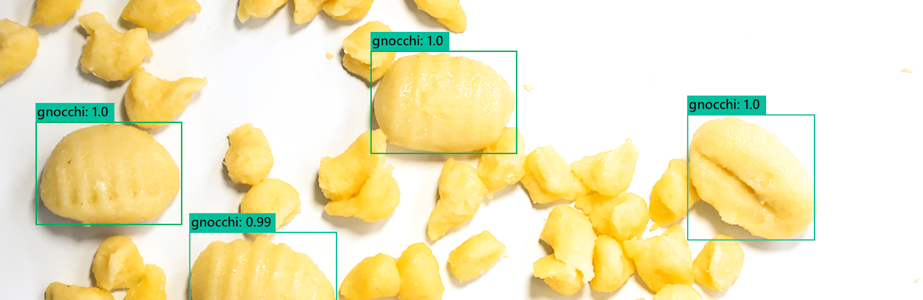
Visual Inspection of Pasta
Industry: Food Industry
Challenge: Single-variety packaging despite high shape variability
Solution: Training on the specific morphological characteristics of each variety—the model learns to distinguish the natural variation within a variety from the differences between varieties
Method: Object recognition / classification
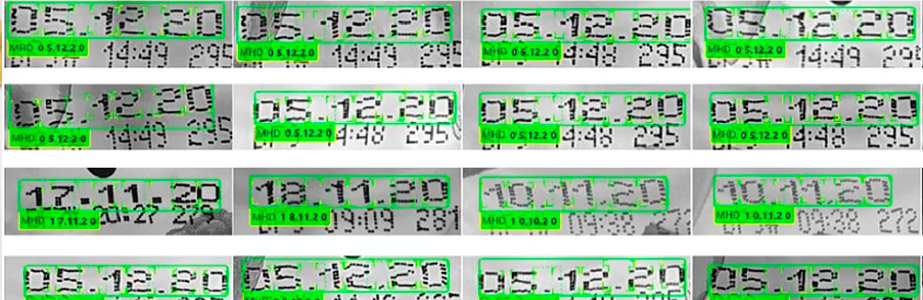
Scanning Codes on Yogurt Cups
Industry: Food Industry
Task: Reading the expiration date
Solution: A combination of optimized lighting for curved surfaces and training in varying print quality—resistant to reflections and smudges
Method: Deep Learning-Based Text Recognition (OCR)
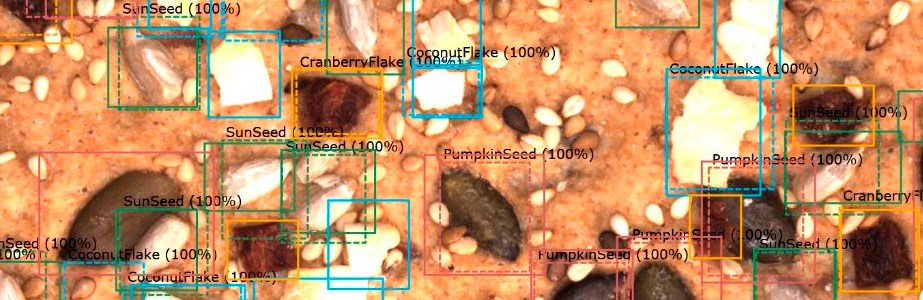
Quality Control in the Production of Crispbread
Industry: Food Industry
Task: Identification of the topping on crispbread, localization of grains and seeds, verification of homogeneity distribution
Solution: Pixel-by-pixel mapping of all coating components enables quantitative analysis—distribution patterns become measurable and comparable
Method: Surface inspection
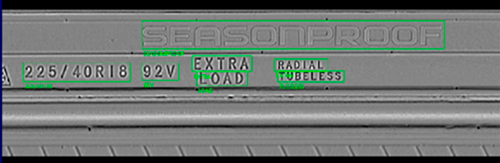
AI-based OCR checks the Code on Tyres
Industry: Automotive, E-mobility
Task: Reading codes on curved surfaces
Solution: 3D scanning generates depth maps; conventional image processing corrects for curvature; deep learning handles the recognition of non-standard fonts in low-contrast conditions
Method: Deep Learning-Based Text Recognition (OCR)
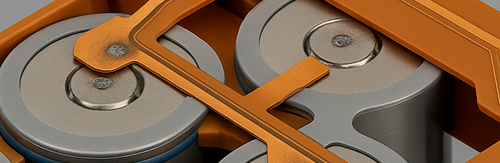
Weld Inspection for EV Batteries
Industry: Automotive, E-mobility, Batteries, Electronics
Task: Automated inspection of welds, verification of the structural properties of welds, testing of electrical quality and conductivity, ensuring the functional safety of battery modules and packs
Solution: Pixel-precise analysis of weld geometry makes pores, spatter, and irregularities visible and quantifiable—the basis for automated quality decisions
Method: Semantic Segmentation
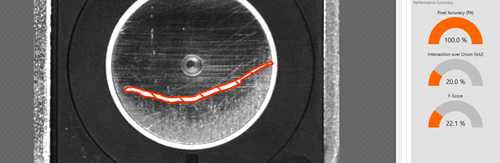
Pre-Weld-Prüfung bei Batteriemodulen
Industry: Automotive, E-mobility
Task: Inspection of Battery Cell Connections Before Welding – Detection of Contaminants and Surface Defects, Verification of Geometry and Pole Alignment
Solution: Two-step approach—first locate the poles, then evaluate the surface and orientation. Errors are detected before they enter the welding process
Method: Object Recognition / Classification
Whitepaper & Technical Article
Vision AI for Industrial Quality Assurance
Fundamentals, Methods, and Decision-Making Tools—from data collection to production operations.

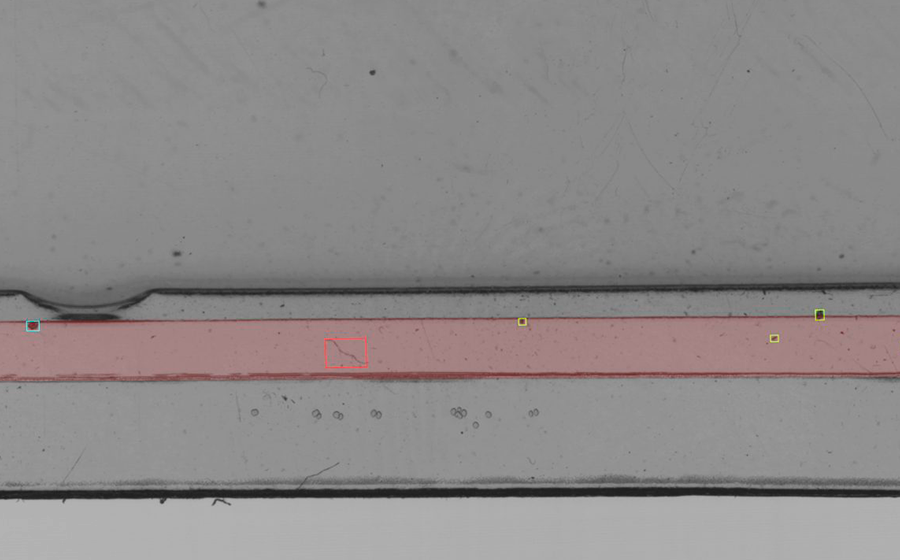
Deep Learning Prevents Delamination…
One of the reasons for delamination of laminated films in plastic packaging is bubble formation…
ROI-Rechner
In Branchen mit geringen Margen stellt sich die Amortisationsfrage direkt: Lohnt sich das System, oder ist ein Mitarbeiter günstiger?